
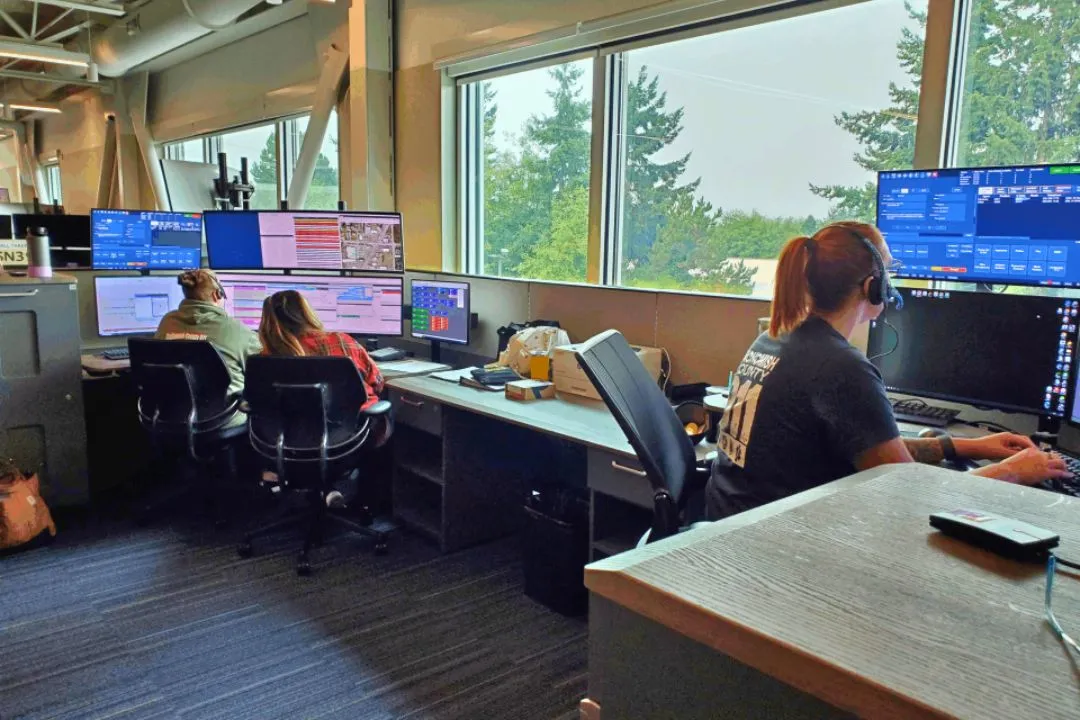
How Snohomish County’s Emergency Communications Center Equipped Their Team to Handle Callers Experiencing Mental Health Crises with Confidence
- Organization: Snohomish County 911 (SNO911)
- Location: Snohomish County, Washington
- Team Size: 111 full-time dispatchers and 16 supervisors (168 total staff)
- Calls Managed: Average of 1,500 emergency (911) calls per day
- Training Engagement: Recurring suicide prevention and active listening sessions as part of the SNO911 New Hire Academy (11+ trainings to date)
- Primary Contact: Alanna Cole, Office of Training and Standards Supervisor)
The Challenge: Preparing Call Takers for the Unthinkable
911 call takers are often the first to hear someone in crisis—and the only voice on the line that might keep them safe. But SNO911 recognized an opportunity to boost existing training in the area of callers in crisis. Adding tools and language that help dispatchers better manage their role in mental health-related calls was a welcome endeavor.
With 911 at the forefront of issues related to mental health and substance abuse in the community, SNO911 brought in Jessi to provide practical, pressure-tested training that matched the weight of the work.

“I wanted to do a deeper dive into dealing with suicidal and mental health callers. Having [Jessi] come in and speak [gave them] specific tools and strategies to help with the callers so responders can get out there.”
— Alanna Cole, Training Director, SNO911
The Solution: Role-Specific Training That Performs Under Pressure
Jessi partnered with SNO911 to design a recurring training experience that gives new hires tactical skills from day one—especially when it comes to managing callers experiencing suicidal ideation, emotionally dysregulated individuals, and critical mental health incidents.
Each session includes:
- Strategic debriefs focused on what works, what doesn’t, and why
- Suicide prevention frameworks customized specifically for emergency dispatchers
- Communication strategies rooted in crisis psychology and active listening skills
- Live role-playing scenarios that simulate actual calls—with real-time coaching
“We don’t want our call takers to be nervous. We want them to be confident when they’re talking to somebody that is in a crisis to help the responders when they get out there. Getting more knowledge to the trainees to have them come in and feel confident with no matter what is on the other end of the line…they’ll be able to have the right training to handle it.”
— Alanna Cole
The Impact: Clearer Communication. Calmer Responses. Fewer Escalations.
After implementing this training across nine new hire academies thus far, SNO911 saw a shift—not just in what trainees knew, but in how they handled their calls in real time.
The most tangible outcome? Call takers are better equipped to process complex mental health-related calls more effectively—with confidence.
“It’s a really big accomplishment because they get done with the call, they hang up, they take a deep breath, and they’re like, ‘I just did that all by myself. Oh my gosh, I can do anything.’”
— Alanna Cole
The benefit hasn’t stopped with mental health calls. Trainees are using the same skills to de-escalate everything from domestic disputes to emotionally volatile emergencies—and because the training is hands-on and high-energy, even the quietest participants stay engaged and walk away with tools they remember.
SNO911 trainee feedback
“Jessi’s role-playing scenarios highlighted the different techniques we can use to connect with a caller. She helped me to understand the importance of connecting with the caller, and I have experienced improvements in my call control and caller cooperation as a result of using some of these strategies.”
“I really enjoyed her presentation. It gave us the opportunity to test different strategies and get feedback at dealing with callers going through a mental crisis. I feel that it better prepared us to have a guideline of what to say and how to say it.”
“Jessi’s class was very informative and has helped me process calls involving individuals in a mental health crisis. I especially enjoyed the role-playing portion of the class… Her class helped me become more empathetic and understanding of people going through difficult times.”
What This Means for Other Organizations
When you operate in a high-stakes environment—whether it’s a dispatch center, a crisis line, or a frontline team—your people can’t afford to freeze when someone’s life is on the line.
SNO911 didn’t wait for a tragedy. They built a training foundation that’s changing how new dispatchers think, speak, and respond under pressure.
“[Jessi brings] an energy when she comes in and gives her presentations. With [Jessi] coming in and being very interactive and energetic and positive, [she] still makes it informative for the class. It’s very engaging, and they take away a lot.”
— Alanna Cole
Want to Equip Your Team Before the Next Crisis Hits?
Schedule a consultation to learn how the Crisis Readiness Group can help your organization build a crisis-ready culture with suicide prevention and communication training that actually works.
Disclaimer: While this training equips SNO911 call takers with enhanced communication tools and crisis response strategies, it is not intended to replace clinical intervention or professional mental health services. Dispatchers are not licensed behavioral health professionals, and their role remains focused on triaging emergencies and coordinating appropriate responder support. The training is designed to help call takers manage high-stress interactions more effectively within their scope of responsibility—not to diagnose, treat, or resolve underlying mental health conditions.