
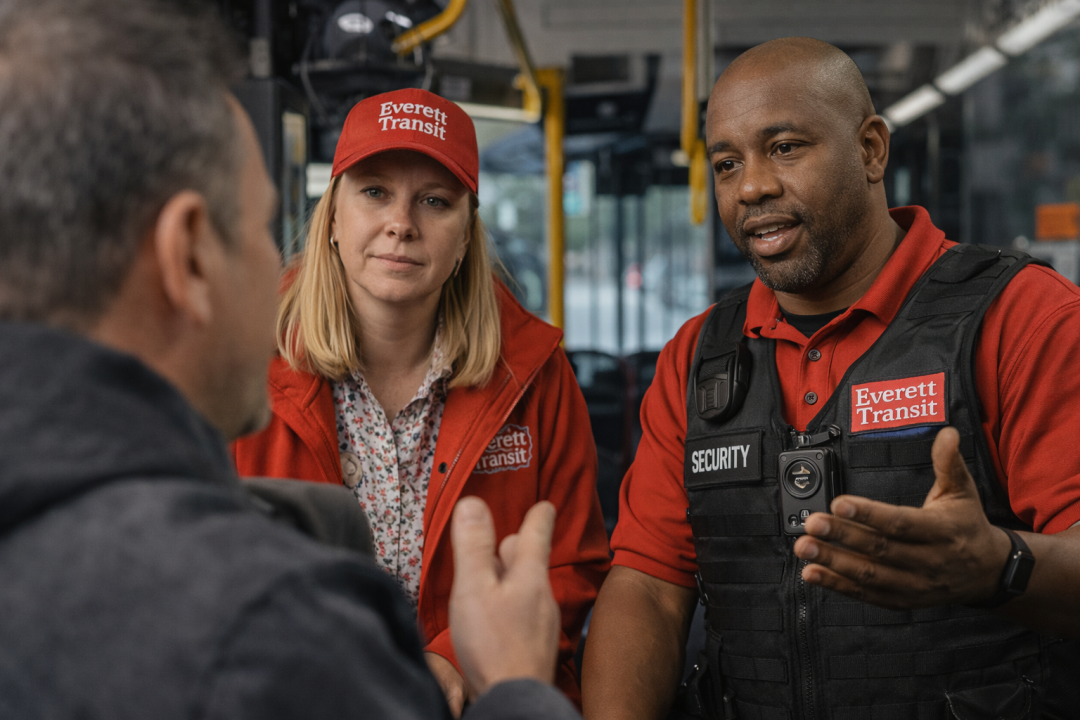
How Everett Transit Equipped Its Drivers and Staff with Tactical Listening Skills to Prevent Violence Before It Starts
- Organization: Everett Transit
- Location: Everett, Washington
- Training Audience: ~100 attendees including bus drivers, inspectors, supervisors, security staff, and administrative personnel
- Training Delivered: Verbal De-Escalation Training focused on tactical active listening skills
- Primary Contact: Brian Senyitko, Operations Supervisor (Risk Management)
The Challenge: Verbal Confrontations Escalating Into Violence
Public transit operators work on the front lines of community safety. Every day, drivers and staff interact with hundreds of passengers; most are routine, but some become emotionally escalated.
Everett Transit’s leadership noticed a troubling pattern: a growing number of physical attacks on drivers that began as verbal confrontations.
To address this risk proactively, Operations Supervisor Brian Senyitko sought training that would help staff:
- Enforce rules without escalating tension
- Respond effectively to emotionally dysregulated passengers
- De-escalate conflicts before they turn into violence
The goal wasn’t just awareness. It was giving staff specific tools they could use in the moment.
The Solution: Tactical Listening Skills for High-Pressure Situations
Jessi delivered a focused verbal de-escalation training built from the L.I.F.E. Model of crisis intervention, concentrating on the first and most foundational step: Listen.
Instead of theory-heavy instruction, the training provided 12 tactical active listening skills that transit employees could use to stabilize emotionally escalated interactions.
The session emphasized:
- Practical language for tense conversations
- Real-world examples of de-escalation in action
- Small communication adjustments that reduce defensiveness
- Techniques for building rapport quickly with strangers under stress
With roughly 100 employees in attendance – from frontline drivers to administrative staff – the session equipped the entire team with a shared communication framework.
Participants highlighted several elements that made the training resonate, including:
- “Story about the boy who wanted more from his father”
- “Real world examples”
- “Recommendation for using ‘and’ instead of ‘but’”
- “Delivery of material”
- “Story about the boy who wanted more from his father”
The Impact: Immediate Gains in Confidence and De-Escalation Skills
Post-training survey results showed meaningful improvements across multiple indicators of effective crisis communication.
- 33% increase in confidence in participants’ ability to de-escalate someone in crisis
- 22% increase in intent to intervene when faced with someone experiencing a crisis
- 75% reported meaningful improvement in their verbal de-escalation skills
- 58.3% reported improvement in their ability to build rapport with someone in crisis
- 50% reported improvement in empathy and reduced stigma toward people experiencing mental health crises
- 50% reported increased belief that they can positively impact someone in crisis
These outcomes reflect a shift not just in knowledge, but in mindset and readiness. Participants also described tangible benefits they took away from the session:
- “Methods to build rapport with customers.”
- “Gave me some tools to use in conversations with someone in crisis.”
- “Improved confidence with de-escalation.”
- “A better perspective for how to communicate with people in a crisis.”
- “More tools for de-escalation.”
Interestingly, the tools resonated even beyond the workplace. This highlights a powerful truth about crisis communication: the skills that prevent workplace conflict are the same ones that strengthen everyday human connection.

“I don’t work in a field where I encounter people with crisis (I work on the admin team) but honestly, I could use some of this with my kid. Also good tools for being out and about in the world.”
— Trainee feedback
What This Means for Other Organizations
When employees interact with the public – whether on buses, job sites, hospital floors, or customer service counters – conflict is inevitable.
The difference between a tense conversation and a dangerous escalation often comes down to communication in the first few moments.
Everett Transit recognized that protecting their drivers didn’t just mean physical safety measures. It meant giving their team the verbal tools to stabilize situations before they spiral.
Organizations that equip their people with these skills don’t just reduce risk; they build teams that are more confident, capable, and resilient in high-pressure interactions.
The final word…
De-escalation isn’t about saying the perfect thing.
It’s about listening well enough to lower the temperature of the moment and change the outcome of the interaction.
For Everett Transit, investing in those skills means their people are better prepared to handle difficult encounters safely, professionally, and with confidence.
Want to Equip Your Team to De-Escalate Conflict Before It Turns Dangerous?
Schedule a consultation to learn how the Crisis Readiness Group can help your organization train for verbal de-escalation, crisis communication, and suicide prevention with tools that actually work in the real world.